
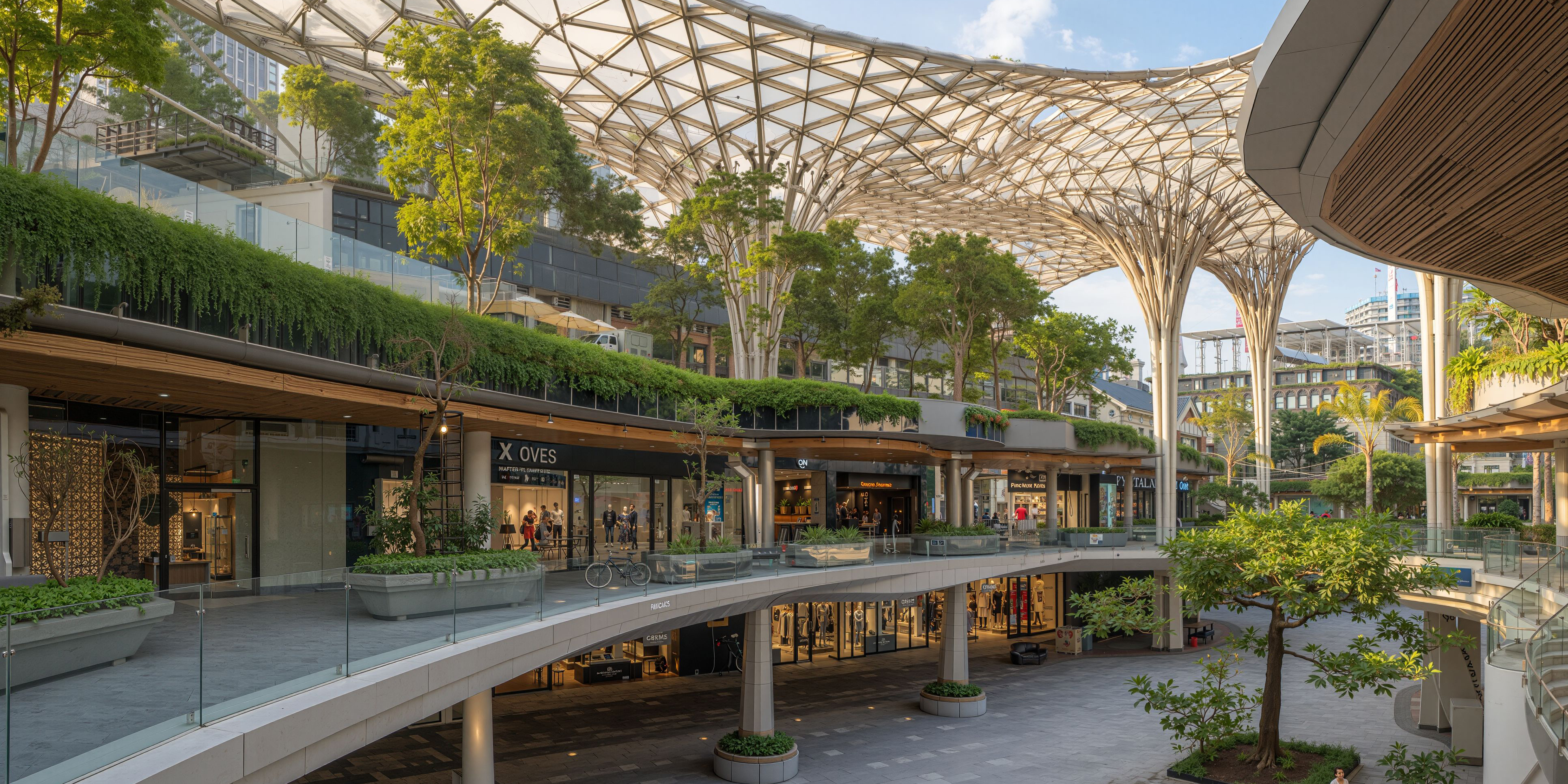
Landscapes tell stories — of wind, water, light, and time. They grow, fade, recover, and change in ways that no static plan can capture.
Today, when sustainability defines the future of design, architects need tools that let them see these forces as part of their creative process.
That’s exactly where AIRIlab plays its role. By combining design intelligence with AI-powered visualization, the platform enables architects and landscape designers to represent weather, climate, and ecology as living elements in their images — not background decoration.
It’s not about forecasting the planet. It’s about learning to design with its rhythm in mind.
A New Lens on Climate-Responsive Design
Every outdoor space begins with light. AIRIlab’s atmosphere controls allow designers to experiment with sunlight intensity, color tone, and direction — showing how a plaza or garden feels at dawn, in noon glare, or just before rain.
These visual shifts help communicate design intent: pergolas that shade correctly, reflective pools that soften brightness, textures that breathe under changing skies. They don’t model real meteorology; they translate the feeling of climate through believable imagery.
That emotional accuracy turns technical sustainability into something everyone can understand.
Visualizing Ecology as Experience
Sustainability is often trapped inside reports — soil data, plant lists, irrigation charts. AIRIlab brings it back to the surface.
With its Render, Inpaint, and Insert Object tools, designers can populate spaces with native trees, porous pavements, or bioswales that manage rainwater naturally.
Each addition respects proportion and scale, ensuring vegetation and material behave realistically inside the composition. The result is a visualization that reads like ecology in motion — people, terrain, and vegetation existing in visual harmony.
Smart Edit: Fine-Tuning the Environment
Tiny adjustments can transform how sustainable a scene looks and feels. Using Smart Edit, designers can:
- Warm or cool lighting to suggest seasonal variation.
- Replace reflective surfaces with matte, low-heat finishes.
- Add or soften vegetation density to balance shading.
All of this happens in seconds, without re-rendering the full image. It’s the designer’s equivalent of weathering — a way to test and refine micro-climates visually before anything is built.
Sustainability Through Atmosphere
True sustainability isn’t always visible in diagrams, but it can be seen in atmosphere. When visuals carry believable light, shadow, and texture, they convey how the environment reacts to design choices.
AIRIlab’s Atmosphere Swift lets architects explore those reactions fluidly — switching from clear to cloudy, from dry to humid tones, to express environmental sensitivity.
Clients begin to sense what a comfortable, climate-responsive space feels like rather than simply hearing numbers about it. That shift — from data to perception — drives real understanding.
Collaborating Across Disciplines
Landscape design rarely happens in isolation. Architects, environmental consultants, and urban planners all contribute.
Because AIRIlab runs entirely in the browser, teams across cities can collaborate on the same project visual in real time. The architect focuses on spatial order, while the landscape designer tests greener edges or water bodies.
The shared view keeps every decision aligned — aesthetic, functional, and ecological at once. This seamless collaboration saves not just hours but creative energy, keeping the design conversation alive and visual.
Turning Technical Goals Into Emotional Clarity
When stakeholders review a sustainable design, they want to feel the result — not read the methodology. AIRIlab helps translate technical goals into images that evoke trust and excitement.
Replace asphalt with textured stone, add native grasses along walkways, lower glare around gathering zones — each small change, instantly visualized, reinforces the project’s environmental logic.
The message becomes clear without a single sustainability label: This design belongs to its climate.
Speed That Enables Exploration
In conventional workflows, rendering a new lighting or vegetation option can take hours. With AIRIlab’s AI acceleration, exploring alternatives happens in real time.
That agility encourages experimentation — the essence of sustainable design. Teams can test multiple orientations, materials, and green elements within a single session.
When iteration is effortless, better environmental decisions follow naturally.
From Representation to Responsibility
While AIRIlab isn’t a weather simulator, its intelligent image generation helps designers think like one. By visualizing how atmosphere interacts with form, it cultivates awareness — of orientation, material heat, and ecological texture.
In that sense, every render becomes a small act of environmental empathy. Designers learn to consider not just how a space looks, but how it lives under sun, wind, and rain.
A Real Example
A firm preparing a concept for a riverside park needs to show two possibilities: one heavily built, one nature-integrated.
Within AIRIlab, they open their base model. Using Inpaint and Insert Object, they add vegetation and reflective water surfaces. With Smart Edit, they lower surface brightness to mimic cooler ground temperature.
Within an hour, the client sees a side-by-side comparison — both equally detailed, but one clearly more comfortable and ecological.
No external simulation. Just visualization that tells the truth beautifully.
Why It Matters
Sustainability used to be explained through words; now it can be shown through light. That’s the quiet power of AIRIlab’s approach — making climate and ecology visible through design intelligence.
It doesn’t promise to predict weather. It gives designers the ability to express environmental awareness with honesty, speed, and craft.
And sometimes, that’s what inspires real change — when understanding starts with seeing.
Conclusion
Designing sustainable landscapes means designing for life — sunlight, growth, reflection, and renewal.
Through its AI-assisted visualization tools, AIRIlab helps architects illustrate those ideas clearly and credibly. By merging atmosphere, ecology, and spatial logic into one workflow, it turns environmental intent into visual experience.
Because when design shows respect for its climate, the world responds in kind.